RSS

Wednesday, June 24, 2015

SihanoukVille


Beaches and Islands The town of SihanoukVille is surrounded on 3 sides by the Bay of Thailand.  From the beaches and surrounding hills, many of the country's small islands can be seen.  Many of the beaches are filled with grass hut restaurants and bars, some of the beaches are rocky, a couple are big resorts, and some are pure sandy beach.  A dozen Islands surround SihanoukVille, and these are fairly unspoiled for the moment.  Beaches, forest treks, diving, swimming, and chilling are the main activites here.
Activities Many vacation activities around town are related to the beaches. Swimming and sunning, trips to the islands, fishing, and snorkeling.  Within town, there are many themed restaurants and bars owned by people from all over the world.  Buddhist temples, mountain biking, dirt biking, walking around downtown and the central
market
, shopping, Mini Golf, and seeing the Cambodian culture are also popular activities.  Scuba Diving is also very popular.
Day Trips Many close by stops await you outside downtown SihanoukVille. The fishing village at Stung Hauv, Kbal Chay Waterfalls, Ream National Park, day trips to the islands. You can even holiday in the coastal towns of Kampot, Kep and Bokor Mountain, just 2 hours away.  Lots of boat trips to the islands.
Night Life Daylight ends around 6pm here, and the vacation continues.  Many beach restaurants stay open until the last customer leaves.  Restaurants with French, Japanese, Italian, Indian and many other cuisines come to life.  Some bars and the 8 casinos are open 24 hours a day.
Transportation There are a few ways to get around town.  While many tourist walk, there are also motorcycle taxi's and Tuk Tuks (carts pulled by a motorcycle) on every street.  To get to SihanoukVille, you can take a car or bus from Koh Kong, near Thailand.  From Vietnam, Kampot or Phnom Penh, a bus or car. And cruise ships and Naval ships regularly dock at the port in town.  Flights arrive at Phnom Penh and then it's a 3 to 5 hour countryside ride to town from the airport by private taxi or by bus from downtown.  Flights also arrive at the SihanoukVille Airport from Siem Reap (Angkor Wat).
Accommodations SihanoukVille offers places to stay ranging from $2 a night, to an island resort costing thousands of dollars per day.  Most hotels and guesthouses are either downtown, on "The Hill", or on one of several beaches. Typical rooms run $6 to $50.  $6 gets you a basic fan room, $10+ gets you a nice room with air-con, cable TV, private bath and fridge.  $25+ and you might get a poolside room.  $50 and up gets you a nicer, bigger room, or better location (think BEACH). 

Souce : www.sihanoukville-cambodia.com

Rural Walking Tour in the Cambodian Countryside


Crossing vast green paddy fields, this 7 km walk gives you an intimate glimpse of rural areas as you wind through picturesque villages. Discover the local pagoda, shops, and school and meet local families with plenty of opportunities to ask them about themselves with your local English and French speaking guide as translator. Along the way you will learn much about seasonal farming activities, rural living conditions, and social issues.

THE HISTORY OF THE ANGKOR WAT TEMPLES


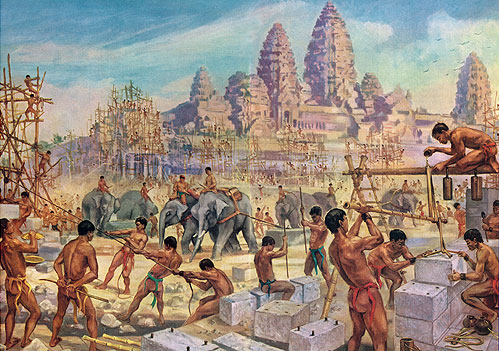
The Angkor Wat temples were built between 800AD to 1300AD. During this time over 27 kings ruled this large territory, about 400 Square kilometers (250 square miles) in north western Cambodia. The temples are thought to have been abandoned around the 15th century. They were built by the Khmer Empire which was one of the greatest powers in South-East Asia. The 'Khmer' refers to the dominant ethnic group in modern and ancient Cambodia. It is estimated that at its height of rule the population contained more than one million people. The temples are not only impressive because of the beauty. It is also amazing to marvel at the vast waterworks and military defenses that were put in place. They were quite advanced for their time.
WHO BUILT THEM?
Many Khmer kings built the amazing temples, defense walls and reservoirs. The Angkor period began with the rule of King Jayavarman II who was responsible for a vast number of the monuments and temples. He built many temples for himself, his mother and father. King Indravarman I was responsible for building the 650 hectares of reservoirs. This was a massive irrigation system that provides water to most of the Angkor Wat areas. It was because of this reservoir that Angkor Watt could sustain and support its large population.
Suryavarman II was responsible for the construction of the most famous temple, Angkor Wat temple. It was constructed in the late 12th to early 13th century. This temple is the pride of the Cambodian people, as it stands on their national flag.

A BIT OF INFO ABOUT THE TEMPLES!

Here is a bit of a summary about some of the major temples that are a must to see when you go to Siem Reap. However, please note there are heaps more and this is just a quick summary.
Angkor Wat, in its beauty and state of preservation, is unrivaled. Its mightiness and magnificence bespeak a pomp luxury surpassing that a pharaoh or a Shah Jahan, an impressiveness greater than that of the pyramids an artistic distinctiveness as fine as that of the Taj Mahal.

Angkor Wat

Location: six kilometers (four miles) north of Siem Reap
Date: early 12th century (between 1113 and 1150) with later additions
Style: Angkor Wat
Reign: Suryavarman II
Visit: several hrs. (More than one visit recommended)

Highlights

The world largest religious monument A completely realized microcosm of the Hindu universe, Culminating in the five peaks of Mount Meru Architectural masterpiece in fine proportions and rich in detail; The apogee of classical Khmer construction some 600 m of narrative bas relief and nearly 2,000 Apsaras.
For once , the modern name of a temple is completely justified. Angkor Wat the city which became a Pagoda was not only the grandest and most sublime of all the Khmer temples, but also a city in its own right. It was built during the reign of Suryavarman II ,in the first half of The 12th century, both as the capital and the state temple dedicated to Vishnu.

Plan

The outer limits of Angkor Wat are set by its broad moat,faced in laterite and sandstone. Including this , the total area is almost 200 hectares-a retangle of 1.5 km E-W by 1.3km N-S, the largest temple at Angkor.
Two causeways at W and E cross the 190m-wide moat to outer enclosure, bounded by a laterite wall of 1025m by 802m. Because of Angkor Wat's unusual orientation, the W gopura of this outer enclosure is by far the largest of four.
Within the 82 hectares of the outer enclosure, the temple itself stands in the middle on a terrace measuring 332+258, nearly 9 hectares. The remaining 9/10 thus of the area was taken up with the city, including the royal palace, although of course no trace remains of these Buildings, presumably constructed in light materials.
Following tradition, the palace would have been to the north of actual temple. The temple proper combines two major features of Khmer architecture: a Pyramid and concentric galleries. Pyramid which in most cases were created by mean of stepped terraces date back to the 8 century Ak Yum and the better known 9th century Bakong, and were the Khmer method of symbolizing the center of the Hindu universe, Mount Meru, in the form of a temple mountain. Galleries, however, evolved later, around beginning of the 11th century; they were natural succession to a growing number of annex buildings surrounding the Sanctuary. Angkor Wat is, to put it as simply as possible, a Pyramid of three levels, each one enclosed by a well -developed gallery with four gopuras and corner towers. The summit is crowned with five towers in a quincunx.
Source : www.angkor-temple-guides.com